
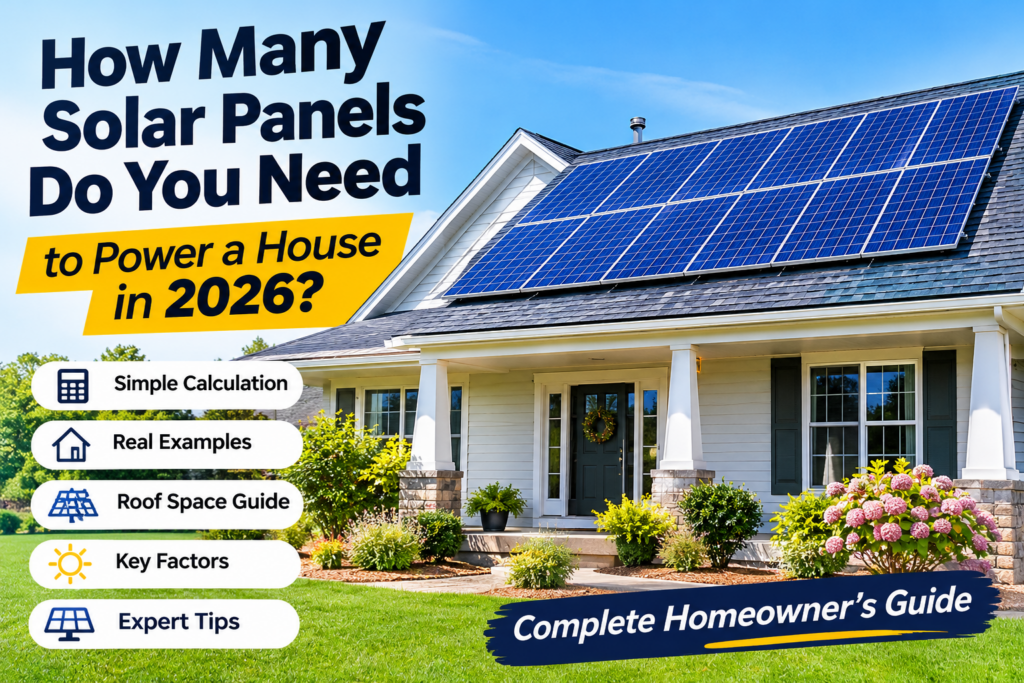
How Many Solar Panels Do You Need to Power a House in 2026?
Thinking about installing solar panels on your home? One of the first questions homeowners ask is: how many solar panels do I need to power my house? The answer depends on your household electricity consumption, location, roof direction, sunlight availability, panel wattage, and the amount of electricity you want your solar system to generate.
Installing too few panels may leave you buying electricity from your utility company. Installing too many can increase your upfront investment unnecessarily. This guide explains how to estimate the right number of solar panels for your home in 2026, with simple calculations, practical examples, and helpful resources.
How Many Solar Panels Does an Average Home Need?
There is no universal number of solar panels for every home. A household using 6,000 kWh of electricity annually will generally need a smaller solar system than a household using 15,000 kWh per year.
For an illustrative example, a home using 10,800 kWh of electricity annually, with suitable sunlight and 400-watt panels, might need approximately 19 panels under the assumptions used in this guide.
| Annual electricity use | Illustrative system size | Approx. 400W panels |
|---|---|---|
| 6,000 kWh | 4.1 kW | 11 |
| 9,000 kWh | 6.2 kW | 16 |
| 10,800 kWh | 7.4 kW | 19 |
| 12,000 kWh | 8.2 kW | 21 |
| 15,000 kWh | 10.3 kW | 26 |
These are simplified planning examples, not guaranteed system recommendations. They assume 5 peak sun hours per day and an overall system performance factor of 80%. Actual production varies by location, season, roof conditions, equipment, and shading.
What Determines How Many Solar Panels You Need?
1. Your Household Electricity Usage
Your electricity consumption is the most important starting point. Check your recent utility bills to find your annual electricity usage in kilowatt-hours (kWh). If your bill only shows monthly usage, add the usage from 12 months to understand your yearly requirement.
Do not estimate your needs using only one month’s bill. Air conditioning, heating, and seasonal appliances can cause significant changes in electricity consumption throughout the year.
2. Your Location and Sunlight
Solar panels generate different amounts of electricity depending on local sunlight conditions. Homes in sunnier locations may generate more electricity from the same system size than homes in areas with frequent cloud cover or shorter winter days.
Installers use local solar production data and peak sun hours to estimate how much electricity a system can generate. Your location-specific estimate is more useful than relying on a national average.
3. Solar Panel Wattage
Solar panel wattage indicates the panel’s rated power under standard test conditions. Residential panels come in different wattage ratings, so the number of panels required depends partly on the model you choose.
For example, a 400-watt panel has a rated capacity of 0.4 kW. A system requiring 8 kW of panel capacity would need approximately 20 such panels before considering design adjustments.
4. Roof Size and Direction
Your roof must have enough suitable space for the panels. Roof direction, tilt, shade from trees, nearby buildings, chimneys, and other obstructions can affect solar production.
A roof with limited usable space may require higher-wattage panels or a different system layout. A professional site assessment can help determine what is practical for your home.
5. Your Future Electricity Needs
Think about whether your electricity consumption may increase in the coming years. Adding an electric vehicle, heat pump, pool equipment, or additional air conditioning can increase your home’s energy requirements.
Discuss future electricity needs with your installer before finalizing the system size.
How to Calculate the Number of Solar Panels You Need
Step 1: Find Your Annual Electricity Usage
Suppose your household uses 10,800 kWh of electricity per year. You can find this figure by checking your utility bills or online electricity account.
Step 2: Estimate Daily Electricity Usage
Divide annual electricity usage by 365 days:
10,800 ÷ 365 = approximately 29.6 kWh per day.
Step 3: Estimate the Solar System Size
For this example, assume 5 peak sun hours per day and an overall system performance factor of 80%.
System size = Daily electricity usage ÷ (Peak sun hours × Performance factor)
29.6 ÷ (5 × 0.80) = approximately 7.4 kW.
Step 4: Calculate the Number of Panels
Assume each solar panel has a rated capacity of 400 watts, or 0.4 kW.
7.4 kW ÷ 0.4 kW = 18.5 panels.
Since you cannot install half a panel, the initial estimate is approximately 19 solar panels. A professional system design may recommend a different number after reviewing roof conditions, equipment specifications, and local production estimates.
Helpful Solar Calculators and Resources
Before choosing a solar panel system, use reliable tools to understand your home’s solar potential and estimate electricity production.
- NLR PVWatts Solar Calculator – Estimate solar electricity production using your location and proposed system details.
- U.S. Department of Energy: Solar Rooftop Potential – Learn how roof size, shading, direction, and location affect solar suitability.
- NLR System Advisor Model: Photovoltaic – Explore more detailed solar photovoltaic system modeling.
These tools provide useful preliminary estimates. They do not replace a professional roof inspection or an installer quotation.
How Much Roof Space Do Solar Panels Need?
The amount of roof space required depends on the physical dimensions of the panels and the layout of the system. As a simple illustration, if one panel occupies around 20 to 22 square feet, 19 panels may require roughly 380 to 418 square feet of panel surface area.
Additional space may be needed for setbacks, access pathways, roof obstructions, and local fire-safety requirements. The installer should confirm the usable roof area before providing a final design.
Should You Install Enough Panels to Cover 100% of Your Electricity Use?
Not every homeowner needs a solar system designed to offset exactly 100% of annual electricity consumption. Your ideal system size depends on electricity prices, utility compensation for exported power, available roof space, and your budget.
Some utility companies offer net metering or other export arrangements, while others use different billing structures. These policies can affect the financial value of producing more electricity than your home uses at a particular time.
Before choosing a system, ask your utility company how solar exports are credited and whether any special interconnection requirements apply.
Do You Need a Solar Battery With Your Panels?
A solar battery is optional for many grid-connected solar installations. Without a battery, your home can use solar electricity while it is being generated and may draw electricity from the grid when solar production is insufficient.
A battery can store excess solar energy for later use and may provide backup power during outages if the system is designed for that purpose. However, battery capacity, installation cost, and compatibility should be evaluated separately.
Read our related guide: Solar Battery Storage Cost in 2026: Complete Homeowner’s Guide to understand battery sizing, installation expenses, and buying considerations.
Common Mistakes to Avoid When Choosing Solar Panel Quantity
- Using only one electricity bill: Review a full year of usage to account for seasonal changes.
- Ignoring roof shading: Trees and nearby buildings can reduce electricity production.
- Choosing panels only by price: Compare wattage, efficiency, warranty, and manufacturer support.
- Ignoring future electricity needs: Consider planned electric vehicles or new appliances.
- Assuming every home needs 100% offset: Utility billing policies and export rates matter.
- Skipping professional assessment: Roof condition, electrical equipment, and local rules should be checked.
Questions to Ask a Solar Installer
Before signing a solar installation contract, ask the installer to explain:
- How much electricity will the proposed system generate annually?
- What assumptions were used for sunlight and shading?
- How many panels are being installed and what is their wattage?
- Does the quote include equipment, labor, permits, and inspections?
- What warranties cover the panels, inverter, and workmanship?
- How will the system work with my utility company’s billing rules?
- Can the system be expanded if my electricity needs increase?
Frequently Asked Questions
How many solar panels are needed to run an average house?
The number depends on annual electricity usage, local sunlight, panel wattage, and system performance. A home using 10,800 kWh annually might need around 19 panels rated at 400 watts under the illustrative assumptions in this guide.
Can 10 solar panels power a house?
Ten panels may cover some or a substantial portion of electricity needs in a low-consumption home, depending on their wattage and local sunlight. They may not be enough for a larger household with high electricity usage.
How many solar panels do I need for a 2,000-square-foot house?
Square footage alone cannot determine the correct number. Two homes of the same size can have very different electricity consumption because of insulation, heating, cooling, appliances, and household habits. Use annual kWh consumption for a more useful estimate.
Do solar panels work on cloudy days?
Yes. Solar panels can still generate electricity in cloudy conditions, but their output is generally lower than on sunny days. Actual production depends on cloud cover, panel technology, and local weather.
Can I add more solar panels later?
In many cases, a system can be expanded, but inverter capacity, roof space, electrical design, permits, and utility interconnection rules may limit future additions. Discuss expansion plans before installation.
Do I need a battery with my solar panels?
No. Many grid-connected solar systems operate without batteries. A battery may be useful for backup power or storing excess solar electricity, depending on your needs and local utility rates.
Final Thoughts
Finding out how many solar panels do I need starts with understanding your annual electricity consumption and local solar conditions. Panel wattage, roof space, shading, system efficiency, and future energy needs also play important roles.
Use the examples in this guide as a starting point, then request a professional assessment and compare written proposals from qualified installers. The right solar system is one that fits your home’s electricity needs, roof conditions, and budget.
Explore more practical home energy and improvement guides at GlowHomex.
Disclaimer: This article is for general educational purposes only. Solar production estimates are illustrative and are not a substitute for a professional site assessment or installation quote. Electricity rates, utility policies, equipment specifications, and local requirements may change.