
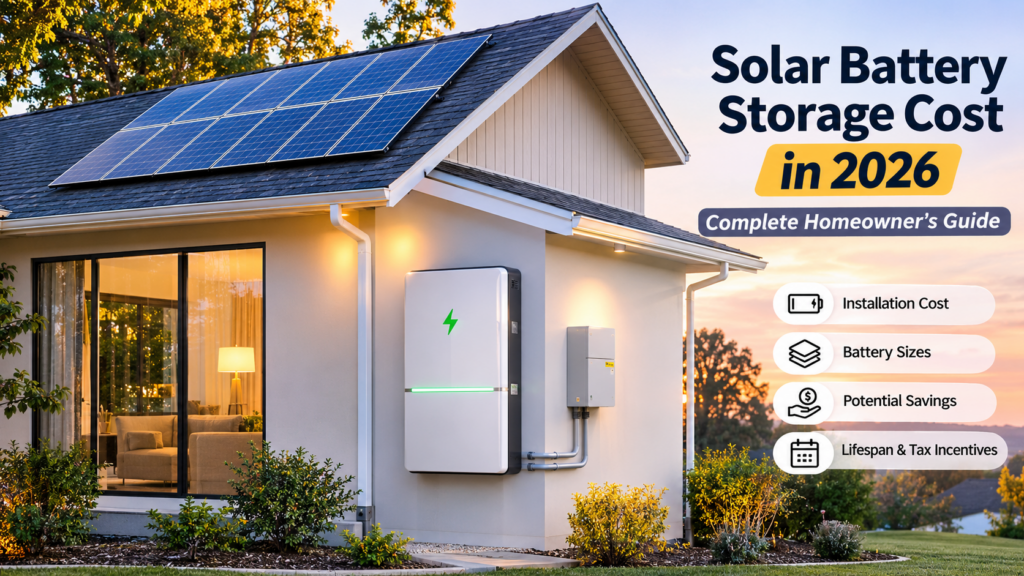
Solar battery storage is becoming an important part of home energy systems across the United States. A home battery can store electricity generated by solar panels during the day and make that energy available at night or during a power outage. However, before installing a system, homeowners should understand the solar battery storage cost, installation expenses, battery capacity, lifespan, and possible savings.
This guide explains the major costs of home solar batteries in 2026, the factors that affect installation prices, and how to decide whether battery storage is a practical investment for your home.
How Much Does Solar Battery Storage Cost in 2026?
The total price of a home battery system depends on its storage capacity, brand, installation requirements, electrical upgrades, and whether it is being installed with a new solar panel system or added to an existing one.
As a general planning estimate, homeowners may encounter prices ranging from several thousand dollars for smaller battery systems to well over $15,000 for larger or more complex installations. These figures are not a guaranteed installer quote, and local labor and equipment prices can change the final amount considerably.
Understanding solar battery storage cost before installation helps homeowners compare battery options, installation expenses, and potential long-term energy savings.
| Cost component | What it includes |
|---|---|
| Battery equipment | The battery unit and its storage capacity |
| Inverter and electrical equipment | Power conversion, controls, wiring, and related components |
| Installation labor | Professional installation, setup, and testing |
| Electrical upgrades | Possible panel upgrades, wiring changes, or other modifications |
| Permits and inspections | Local approvals and required inspections |
For a more complete picture of your solar investment, use our Solar Panel Cost Calculator to explore estimated solar system expenses.
What Factors Affect Solar Battery Installation Cost?
There is no single price that applies to every home. The following factors can make one installation more expensive than another.
1. Battery Capacity
Battery capacity is measured in kilowatt-hours (kWh). It indicates how much electricity a battery can store. A smaller battery may be suitable for essential appliances, while a larger battery may support more household electricity use for a longer period.
Choosing a battery that is larger than your actual needs can increase your upfront cost. On the other hand, a battery that is too small may not provide enough backup power.
2. Battery Brand and Technology
Different manufacturers offer different battery technologies, warranties, monitoring features, and performance specifications. Lithium-ion batteries are commonly used in residential storage systems. Compare usable capacity, warranty coverage, efficiency, and manufacturer support instead of choosing a battery based only on its advertised price.
3. Installation Complexity
Installation costs can increase if your home needs additional wiring, electrical panel modifications, new equipment, or a more complicated battery location. Local permitting and inspection requirements can also affect the total project cost.
4. New Solar Installation or Battery Retrofit
Installing a battery together with a new solar panel system may allow some equipment and installation work to be planned together. Adding a battery to an existing solar system can require compatibility checks and additional electrical work. Ask installers to explain exactly what equipment your home needs.
What Size Solar Battery Does Your Home Need?
The right battery size depends on how much electricity you use, which appliances you want to keep running, and how long you want backup power to last.
| Home energy requirement | What to consider |
|---|---|
| Essential backup | Prioritize selected lights, Wi-Fi, refrigerator, and essential devices |
| Partial home backup | Include additional circuits and appliances based on their power requirements |
| Whole-home backup | Calculate peak power demand, daily energy use, and expected outage duration |
Remember that battery capacity and power output are different measurements. Capacity, measured in kWh, tells you how much energy can be stored. Power, measured in kilowatts (kW), tells you how much electricity the battery can deliver at a particular moment.
Benefits of Installing a Home Solar Battery
1. Backup Power During Outages
A properly configured battery system can supply electricity to selected household circuits when the grid goes down. The actual backup duration depends on battery capacity, appliance usage, and the system’s design.
2. Better Use of Solar Energy
Without storage, excess solar electricity may be exported to the grid, depending on your utility arrangement. A battery can store some of that energy for use later, such as in the evening when solar panels are no longer producing electricity.
3. Potential Electricity Bill Savings
In areas with time-of-use electricity rates, a battery may help homeowners use stored electricity during more expensive periods. Actual savings depend on utility rates, export compensation, battery efficiency, and system settings.
4. Greater Energy Flexibility
Battery storage gives homeowners another way to manage electricity use. Some systems offer monitoring apps that show battery charge levels, solar production, and household consumption.
Although solar battery storage cost can be significant initially, the right system may provide additional value through backup electricity and better use of solar energy.
Are Solar Batteries Worth It in 2026?
A solar battery may be worthwhile for homeowners who experience frequent power outages, have high evening electricity rates, or want more control over how they use their solar energy.
However, a battery may take longer to justify financially in areas with reliable grid service and favorable net-metering arrangements. The best way to evaluate a system is to compare its total installed cost with realistic expected savings and the value you place on backup power.
Ask at least two or three qualified local installers for written proposals. Compare the equipment, usable capacity, installation charges, warranty, and estimated savings rather than comparing only the final price.
Solar Battery Lifespan and Maintenance
Residential battery lifespan depends on battery chemistry, operating temperature, charging patterns, usage, and manufacturer specifications. Many home battery products come with warranties that specify a coverage period, energy throughput, or remaining-capacity requirement.
Before purchasing, review the warranty carefully and check:
- Warranty duration and coverage conditions.
- Guaranteed remaining capacity at the end of the warranty period.
- Permitted charging and discharging limits.
- Temperature and installation requirements.
- Availability of local service and technical support.
Follow the manufacturer’s maintenance instructions. Keep the battery installation area within the specified temperature and ventilation conditions, and have any warning messages or unusual performance checked by a qualified professional.
Solar Battery Tax Credits and Incentives in 2026
Homeowners should be especially careful when researching federal tax incentives for solar batteries in 2026. The IRS states that the Residential Clean Energy Credit under Section 25D is not available for expenditures made after December 31, 2025. The IRS also explains that an expenditure is generally treated as made when the original installation is completed.
Therefore, homeowners planning a new battery installation in 2026 should not assume that the previous 30% federal residential clean energy credit will apply. Check the latest IRS guidance and speak with a qualified tax professional about your particular circumstances.
You can review the official guidance here:
State, local, and utility incentives may have different eligibility rules and deadlines. Contact your state energy office and utility provider to check whether any current programs are available in your area.
How to Choose the Right Solar Battery Installer
Choosing a qualified installer is just as important as choosing the battery itself. A professional assessment can help prevent overspending and compatibility problems.
Before signing a contract, ask these questions:
- Is the battery compatible with my existing solar inverter?
- How much usable storage capacity will I receive?
- Which appliances and circuits will work during an outage?
- Does the quoted price include permits, labor, and electrical upgrades?
- What warranty covers the battery and installation work?
- Can the installer provide a written estimate of expected savings?
- Who will provide support if the system develops a fault?
Request an itemized quotation and make sure the proposal explains the equipment model, installation scope, warranty, and any additional charges.
Frequently Asked Questions
1. How much does a home solar battery cost in 2026?
The price varies according to battery capacity, brand, installation complexity, and electrical upgrades. Smaller systems may cost several thousand dollars, while larger installations can exceed $15,000. Get local written quotes for an accurate estimate.
2. How many solar batteries does a house need?
It depends on household electricity use, the appliances you want to power, and the length of backup you need. A professional installer can calculate the required capacity using your electricity bills and appliance loads.
3. Can I add a battery to my existing solar panels?
Yes, many existing solar systems can be upgraded with battery storage. However, compatibility with your inverter and electrical equipment must be checked before installation.
4. Can a solar battery power an entire house?
Some systems can support whole-home backup, but the battery must have enough usable capacity and power output for your household demand. Large appliances may require additional capacity or careful load management.
5. Does a solar battery work during a power outage?
It can, if the system is designed and configured for backup operation. Some solar systems automatically shut down during grid outages unless they have suitable battery and backup equipment.
6. Is the federal solar battery tax credit available in 2026?
The IRS states that the Residential Clean Energy Credit under Section 25D does not apply to expenditures made after December 31, 2025. Check official IRS guidance for details and consult a tax professional about your circumstances.
Final Thoughts
Installing a home battery can offer backup power, better use of solar electricity, and greater control over household energy. However, the financial value depends on your electricity rates, utility policies, battery size, installation price, and energy needs.
Before making your decision, compare solar battery storage cost from multiple qualified installers and review the warranty, usable capacity, and installation requirements. A carefully sized system is generally a better choice than simply buying the largest battery available.
Explore more home energy guides and practical tools at GlowHomex.
Disclaimer: This article is for general informational purposes only. Prices, incentives, utility policies, and product specifications may change. Confirm current details with qualified installers, your utility provider, and official government sources before making a purchase.
Pingback: How Many Solar Panels Do I Need in 2026? Proven Homeowner Guide
Pingback: PM Surya Ghar Yojana 2026: Easy Solar Subsidy Guide
Pingback: Best Solar Panel Cleaning Tools in Canada (2026)